2.1K 

From late October 1914 the threat to merchant shipping in The Irish Sea was growing. German U-boat commanders knew that the approaches to Liverpool offered many targets should they wish to attack. For Arthur Evans, the increased risk was apparent. The Velinheli regularly sailed to Garston to import coal and thus had to negotiate the waters of Liverpool Bay when entering and leaving the Mersey. This was wartime
Leonard Evans, who was 12 years old at the time, wrote the following to his cousin, Dr Leslie Doyle in 1978. “The Velinheli was lost in 1915 near the Bar Lightship during a submarine scare in a collision with the steamship, Laertes (from South Africa), all vessels sailing without lights at this


The original bill of sale dated 27th May 1891 for the £850 purchase of the 1878 built Velinheli by Arthur Evans of Greystones from its previous owner, John Deane, a slate merchant. It was in this year that the two largest Welsh slate quarries,
Original records of Arthur Evans & Son show that 130 tons of red bricks were imported by the firm into Greystones harbour in 1892-1893.


Velinheli at Bray pier… March 1906
 atest press release from Greystones historian Gary Paine, issued on
  Friday, January 24th 2025…

 Friday, January 24th 2025…
It was 110 years ago, on 25th January 1915, that the much-loved, Greystones owned top-sail coal schooner Velinheli was sunk near the mouth of the river Mersey.
The indirect, innocent victim of German U-boat activity during WW1, for almost a quarter of a century she had been the workhorse of Arthur Evans’ coal business at the harbour, helping to keep the home fires of Greystones burning. Her loss at the time was keenly felt in the town – this fine pre-1910 view of the Velinheli, either coal-laden or in-ballast alongside the pier was once a common sight for Greystonians.
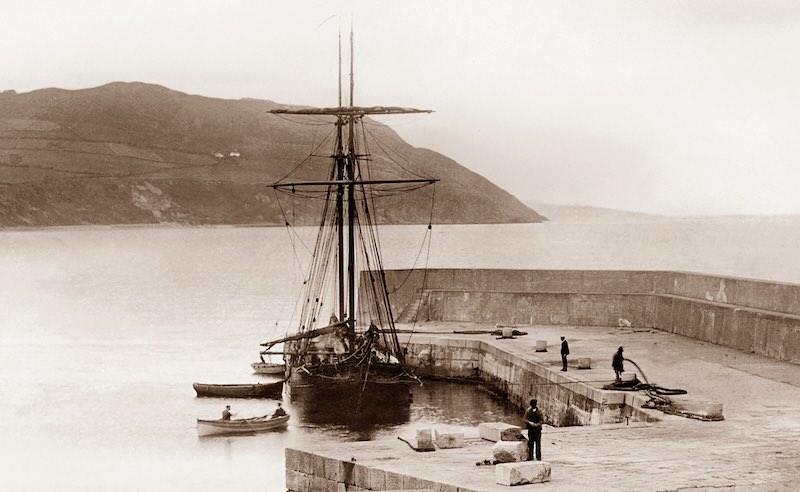
Pre-1910 view of Velinheli
From late October 1914 the threat to merchant shipping in The Irish Sea was growing. German U-boat commanders knew that the approaches to Liverpool offered many targets should they wish to attack. For Arthur Evans, the increased risk was apparent. The Velinheli regularly sailed to Garston to import coal and thus had to negotiate the waters of Liverpool Bay when entering and leaving the Mersey. This was wartime  and every precaution had to be taken to minimise the risk. It was on the evening of Monday, January 25th 1915, when the Velinheli had departed Garston and was in Liverpool Bay, that she was sunk in a collision with the S.S. Laertes, indirectly as a result of the U-boat threat.
 and every precaution had to be taken to minimise the risk. It was on the evening of Monday, January 25th 1915, when the Velinheli had departed Garston and was in Liverpool Bay, that she was sunk in a collision with the S.S. Laertes, indirectly as a result of the U-boat threat.
Leonard Evans, who was 12 years old at the time, wrote the following to his cousin, Dr Leslie Doyle in 1978. “The Velinheli was lost in 1915 near the Bar Lightship during a submarine scare in a collision with the steamship, Laertes (from South Africa), all vessels sailing without lights at this  time. The crew were saved as the S.S. Laertes’ bow was into the vessel amidships and when the crew were aboard the Laertes, the latter reversed her engines and the Velinheli went down. The Admiralty Court awarded the owners compensation equivalent to the repair cost incurred in the storm at Greystones in October 1910 when three vessels were damaged, approximately one eighth of the value of the vessel.”
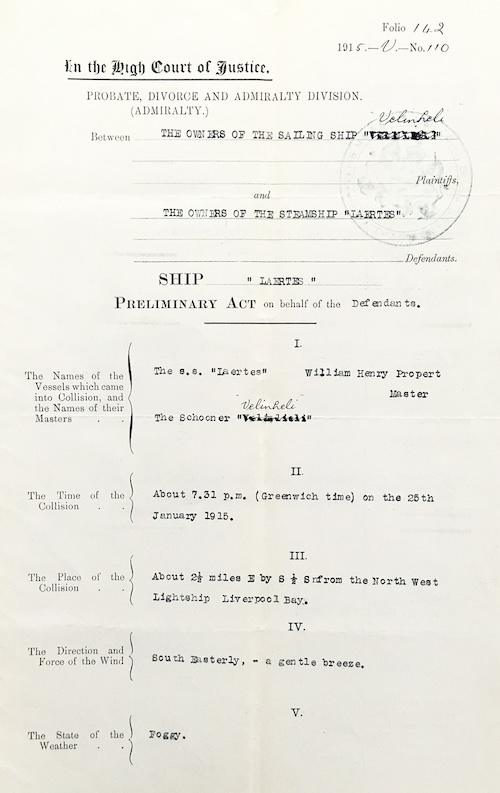 time. The crew were saved as the S.S. Laertes’ bow was into the vessel amidships and when the crew were aboard the Laertes, the latter reversed her engines and the Velinheli went down. The Admiralty Court awarded the owners compensation equivalent to the repair cost incurred in the storm at Greystones in October 1910 when three vessels were damaged, approximately one eighth of the value of the vessel.”
Though the report on the sinking carried in The Liverpool Echo mentioned that there was a dog on board the Velinheli at the time of her loss, the story passed down through the Evans family is that the animal in question was in fact the ship’s cat, which was rescued along with the crew prior to her sinking off New Brighton.

The Velinheli crew…
Above is the only known photo of the Velinheli and her crew although it is unknown if this was her crew at the time of her sinking. The man on the left was the ship’s cook whilst the crew member on the right is holding the ship’s cat – it was common for ships to always have a cat on board.
For almost a quarter of a century the Velinheli had sailed back and forth between Greystones and English, Welsh and Scottish coal ports. Her topsails had been a familiar sight on the horizon as she sailed towards the harbour. Until this point she always had luck on her side.
 In The Wicklow People dated 26th October 1895, a headline ran, A Greystones Vessel In Distress, reporting the following: “On Tuesday the schooner, Velinheli, laden with 140 tons of coal, bound from Garston to Greystones was in distress at the last named place and in consequence of the heavy sea that was running, it was deemed advisable to sink her. Her bottom was auger-bored shortly afterwards and she sank just inside the harbour. If this had not been done, the probabilities are that she would have been wrecked on the beach. The vessel, which is owned by Mr Arthur Evans, Greystones, was successfully floated on Thursday evening”.
  Just over a decade later, she emerged with a damaged keel after being driven ashore just south of Bray harbour in a gale in March 1906.


Most notably however, she was one of three sailing vessels severely damaged during a storm at Greystones harbour in October 1910, a seminal moment in the history of the harbour.
Following the Velinheli’s sinking, for Arthur Evans & Son the decision whether to replace her was straightforward. The compensation received in no way reflected her true value. Furthermore, the issues besetting Greystones harbour, in particular its lack of depth especially at low tide, coupled with the crumbling state of the pier and north wall, meant that she was not replaced. Two weeks after the sinking of the Velinheli, her assailant, the 2,183 ton S.S. Laertes, was sailing from Liverpool via Amsterdam bound for Java with a general cargo.

Bill of Sale 18th May 1891
She came under torpedo and gunfire attack from U-boat U2 off the Netherlands. Though Lloyds’ records listed her damaged, she lived to sail another day. As with the Velinehli, eventually her luck ran out. On 1st August 1917, whilst off Prawle Point in Devon, she was torpedoed and sunk with the loss of 14 lives.
The original bill of sale dated 27th May 1891 for the £850 purchase of the 1878 built Velinheli by Arthur Evans of Greystones from its previous owner, John Deane, a slate merchant. It was in this year that the two largest Welsh slate quarries,  Penrhyn and Dinorwic, began to invest in steam ships, which were more cost-effective to operate in the slate trade. Wooden schooners like the Velinheli which had exported slate were sold to ship owners to operate as coastal trading vessels in the shipment of coal in particular and thus her association with Greystones began.
 Penrhyn and Dinorwic, began to invest in steam ships, which were more cost-effective to operate in the slate trade. Wooden schooners like the Velinheli which had exported slate were sold to ship owners to operate as coastal trading vessels in the shipment of coal in particular and thus her association with Greystones began.
Original records of Arthur Evans & Son show that 130 tons of red bricks were imported by the firm into Greystones harbour in 1892-1893. The log book of the Velinheli covering the six month period from January to June 1893 records her sailing from Bridgwater in Somerset to Greystones. Bridgwater was famous for red brick production and this shipment coincided with the construction of the Grand Hotel on Trafalgar Road, which opened in June 1894.

In a letter to Derek Paine in December 1986 about the era when schooners sailed to Greystones, Dr. Leslie Doyle wrote that ‘the Velinheli particularly was part of the Greystones folklore in the two decades before 1910, the final 20 years of the golden age of the harbour area’.

Final registry entry…
With her top-sail rig, the Velinheli was undoubtedly the most majestic of all the Greystones schooners during the near eight decades when sailing ships called to the harbour. The name Velinheli is the anglicised version of Y Felinheli (the modern name of Port Dinorwic on the Menai Strait where she was built). Felinheli means salt water mill in Welsh.
As was customary for lost vessels, the final entry in the Shipping Register for the Velinheli was written in red ink. It detailed her sinking in Liverpool Bay on 25th January 1915, noting also that her original certificate was lost aboard her.

Velinheli & Reciprocity Shipwrecked Oct 1910 Colourised Colin Doyle

