859 
Having foolishly moved to this neck of the woods from sunny Boston 25 years ago, Hicks’ investigations into her adopted


Kennedy retreated to his house on St Nicholas St in Dublin (in the vicinity of Christ Church), and practiced as a lawyer with his younger brother John, and their sons. His sons had been trained in law at Lincolns Inns in London.

For a cause not known, he died shortly thereafter. He had taken his two very young sons with him after the death of his wife, Frances Howard, in the second child’s birth. Her father, Dr. Ralph Howard, went to the Isle of Man to rescue his grandsons and raised them in Dublin and his Shelton Abbey estate. The sons were badly affected by their early trauma and both were dead by 1710. There followed a series of complex financial interactions, and eventually
None of buildings from the time of the Kennedys remains. The first Sir Robert Kennedy and a number of his descendants are buried in the chancel of the old Delgany church’s graveyard.
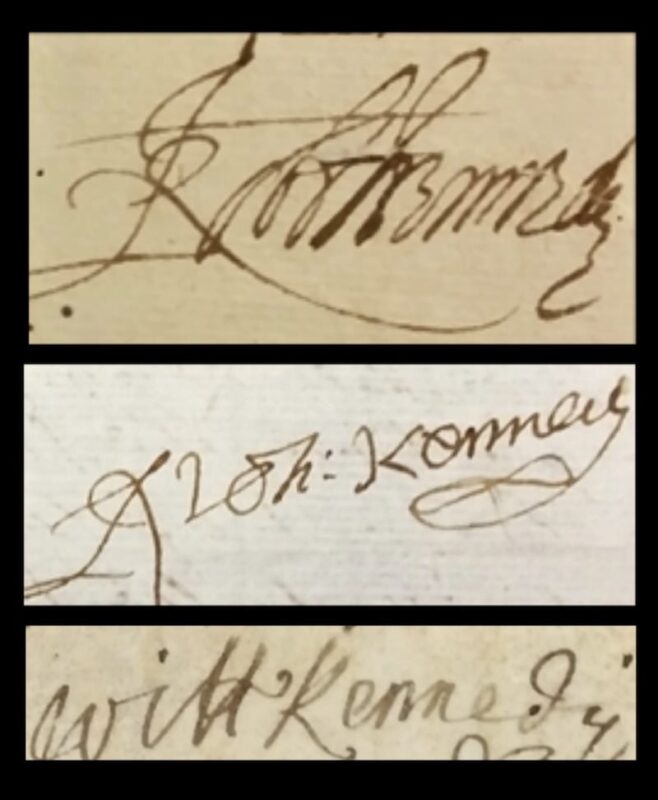
The Kennedy signatures…
 f you’ve ever wondered just how our neighbour Newtown, Mount agus
  Kennedy got its wild and unwieldly name, hey, you’re in luck.
 f you’ve ever wondered just how our neighbour Newtown, Mount
  Kennedy got its wild and unwieldly name, hey, you’re in luck.
For local author Therese Hicks has put together an exhaustive history of the Wicklow town’s namesakes.
Having foolishly moved to this neck of the woods from sunny Boston 25 years ago, Hicks’ investigations into her adopted  hometown’s history led her to the estate papers of the Kennedys of Mount Kennedy.
 hometown’s history led her to the estate papers of the Kennedys of Mount Kennedy.
And from there, a beautiful book, No Mere Irish, was born, charting how this 17th century family were one of the few Gaelic lines who not only became thoroughly anglicised but also embraced Protestantism. Thus booking their place in hell.
 But enough of our half-assed yakking – here’s Therese’s history of the family who mounted the Kennedy onto Newtown…

When I first moved to Newtownmountkennedy in 2002, I wondered who these Kennedys were, but it wasn’t until my retirement in 2014 that I had the time needed to explore their history. An exploration that led me to finding the estate papers of said Kennedys at the National Library of Ireland. They were, unfortunately, written in an obscure style of handwriting from the 1600s, so it took me about 3 years to decipher the 400+ documents.
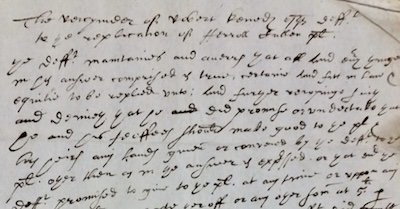
Robert Kennedy’s handwriting…
This is what I learned…
A number of Kennedys had migrated from the greater Tipperary area in the 1500s under pressure from an agreement made with Henry VIII. They took up residence in Dublin, with many of them becoming merchants, a pursuit not hindered by their being Catholics. But as time wore on, religion became a major hindrance for anyone who wanted to seek government offices and the opportunities that went with them.
James Carroll, a wealthy Dublin alderman, who had become a Protestant to gain numerous government posts, befriended Robert Kennedy, who had also become a Protestant.
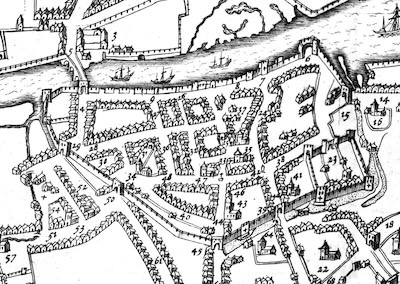
Dublin in the rare, very oul’ times…
He appointed him to the most junior clerk’s post at the Exchequer around 1602.
Kennedy quickly demonstrated considerable networking skills and rose up the ranks at the Exchequer. This allowed him to engage in extensive property speculation, and his financial gains rapidly followed. By 1625, he was able to purchase the plum position of the Chief Remembrancer, the highest, and most powerful, clerical post at the Exchequer.
After considering the land acquisition options at that time, Kennedy began to offer land mortgages to the O’Byrnes and O’Cullens in Newcastle Barony, Co Wicklow. They had been living beyond their means and needed the cash, turning a blind eye to the implications down the line. Kennedy focused his transactions on Ballygarny and what would become the greater Newtownmountkennedy area. Through the late 1620s and 1630s, he gradually became the owner of around 6,500 acres of that part of Co Wicklow.
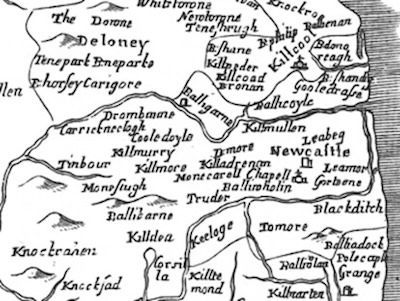
Petty’s 1685 map with Balligarny clearly marked
Then the outrage of Gaelic land loss all over the country exploded in the 1641 rebellion. Kennedy had built up a lucrative agricultural enterprise on his land, as well as constructing a tower house on the old Anglo-Norman motte, the motte being still visible on the Mount Kennedy demesne. His son, Thomas, and brother-in-law, Charles Smith, were in the tower house when the Irish forces attacked. They were lucky to escape with their lives.
The tower was undermined, and the farm ransacked and left fallow.
Kennedy retreated to his house on St Nicholas St in Dublin (in the vicinity of Christ Church), and practiced as a lawyer with his younger brother John, and their sons. His sons had been trained in law at Lincolns Inns in London.  With the arrival of Cromwell, they kept their heads down. But with his death, Kennedy strategically sent his surviving eldest son, Richard, with the group of leading men of the day, to encourage the return of the king, Charles II. As a reward for that action, the king knighted Richard and made him an Exchequer judge, made Robert a baronet, made their estate the manor of Mount Kennedy and gave them another 6,500 acres. It is from this time that Newtown became Newtownmountkennedy.

Sir Richard carried on as a man of status, but the political situation between Ireland and England had shifted. His father had relied on being connected to higher-ups in order to progress in his status. But with the increased suppression of the Gaelic threat, the men of power had moved back to England to be closer to the king. By the time that Sir Richard died in 1685, his son, Sir Robert, could only access the second chamberlain’s post in the Exchequer which provided a paltry income and no networking opportunities.

When James II, a Catholic, came to the throne shortly after Sir Richard’s death, Protestants were losing much of their power. To avoid this pressure, Sir Robert II fled to the Isle of Man.
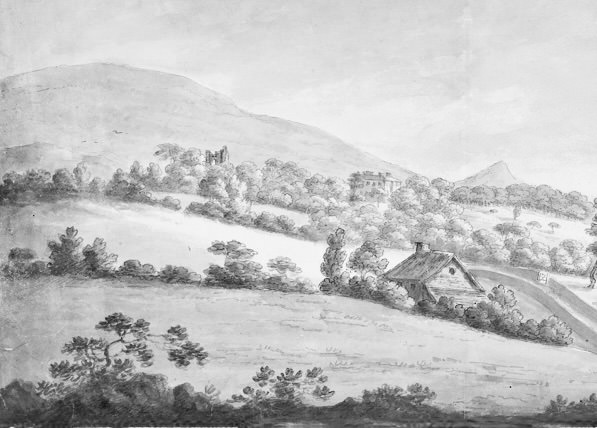
Newtown house 1787 by Christopher Machell
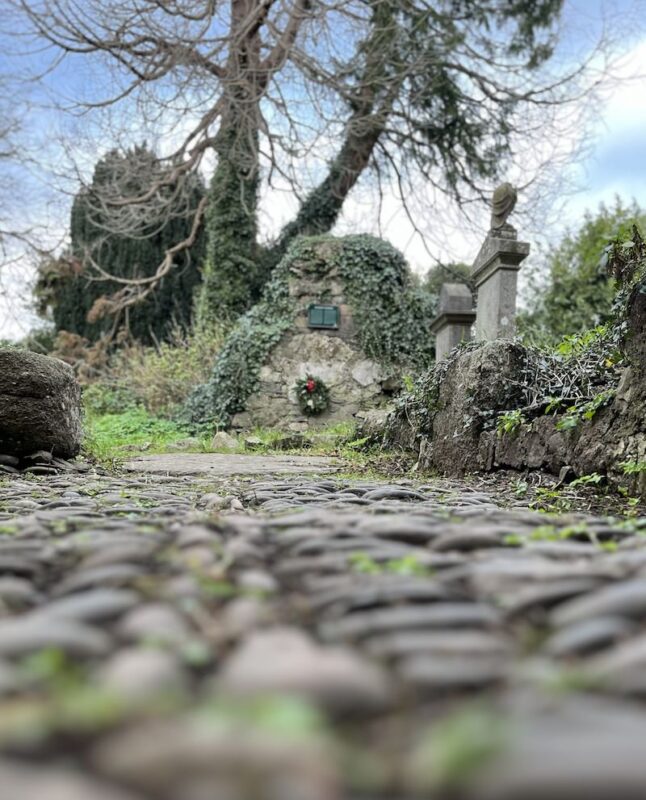 the estate was sold to a Gen. Robert Cunningham in 1753. He built the mansion that now stands on the demesne.
1 comment
dear ms hicks are you going to write the rest of the mount kennedy estate story the gun cunninghams i in the 1950 gun cunningham came to our farm every year and paid my dad 5 pounds to shoot kilmurrey hill to shoot snipe snipe the ultimate shot