2.1K 


Nevill’s map in 1760 was the first to mistakenly leave out the ‘s’, and the Ordnance Survey have perpetuated that error up to the present day. However, the people of the area have kept the original correct version alive down through the centuries in spite of the efforts of newcomers to ‘correct’ them.


He acquired his colourful nickname through nothing more exciting than his powerful voice, said to resemble a foghorn. Locals would sit on the seat in the evenings to tell stories, gossip or have a sing-song. One story was told of two local fishermen who were being constantly asked by a Windgates neighbour to bring him out in their boat.


On one occasion however, everyone except my uncle Noel James got off and the sleigh actually went over the hedge and landed on the main road just after the 84 bus had passed up the hill. Noel was screaming “I’m dead!”, but it turned out he was fine. Noel worked on D’Arcy’s farm, as did many locals, especially at harvest time.
A little mystery now. As small kids, my brother and I used to collect seashells from the roadside banks all the way from the top of Windgates hill down to Booth’s Hollow. I have never been able to ascertain the reason for their presence.
And there has to be a ghost story! In an old book imaginatively called Irish Ghost Stories, there is an account of a man


The eyes have hills…
 t was way back in January 2017 when we mentioned to hairy
  tryker Ray Beach that we were hoping to chart Windgates’ history.
 t was way back in
This slip of a road, this Scalextric swoop of a hill, always struck as being neither quite here nor there.

Windgates Hill 1950s. Ray Cranley
Just its own little piece of meteor, floating in that space just outside Greystones, on the climb over Bray Head, to the dark side. Blink on the bus, and you’d miss it.
“You should talk to Ray Cranley, just up the road,” said the son of a Beach. “He knows everything you’d ever need to know about Windgates. And probably some more besides…”

Enniskerry, yesterday, around 6pm
Of course, it took us a few years to finally catch up with the man himself, at first spotting his paintings, then his books until finally, we met up at one of his Enniskerry fairs last September. There and then we made a pact to get his Windgates childhood up on the Guide.
 And now, a mere, eh, 173 days later, here it is….

Windgates has been Windgates, ending with an ‘s’, since its first mention in 1280 as Le Windgates.
Nevill’s map in 1760 was the first to mistakenly leave out the ‘s’, and the Ordnance Survey have perpetuated that error up to the present day. However, the people of the area have kept the original correct version alive down through the centuries in spite of the efforts of newcomers to ‘correct’ them.  Not only do some folk try to eliminate the ‘s’, they also tell us we have been mispronouncing the name of our homeplace for umpteen generations…

Anyway, ‘Wind’ rhymes with ‘fined’, not ‘sinned’.In recent times, even our know-all friend, Mr. Google, has Lower Windgates down as Lower Templecarrig on his map – just as they have much of Greystones as Killincarrig – playing havoc with the blood pressure of delivery folk.
 The same correction of old locals is happening just down the hill, a lady asking to be let off the bus at Redford being told by the driver that she lived in Redf’rd as in Robert, not in Redford, as in the car. How wonderful in your old age to finally find out where you live!
 The same correction of old locals is happening just down the hill, a lady asking to be let off the bus at Redford being told by the driver that she lived in Redf’rd as in Robert, not in Redford, as in the car. How wonderful in your old age to finally find out where you live!
Okay, rant over. Time for something a little lighter.

Tom The Horn’s Rest
If you are walking to Bray from Greystones you may notice a fifteen-foot long protrusion at the base of the wall outside the cottages at the top of Windgates hill. This is all that remains visible of what was known as Tom the Horn’s Rest, a stone seat built by Tom Byrne at the behest of the Morris family who then lived in Rathdown Cottage, now Fisher’s farmhouse. It was the perfect spot for a much-needed rest after the steep trudge up the hill from Redford.

Tom ‘The Horn’ Byrne & the missus
Tom was a stonemason and a well-known character in the area. He lived in Templecarrig Lodge until moving to the new cottages at Lower Windgates in 1911. Many of the first stone floors were laid in the older mud-floored cottages around Windgates by Tom.
He acquired his colourful nickname through nothing more exciting than his powerful voice, said to resemble a foghorn. Locals would sit on the seat in the evenings to tell stories, gossip or have a sing-song. One story was told of two local fishermen who were being constantly asked by a Windgates neighbour to bring him out in their boat.  They usually refused, knowing this chap had no experience of the sea, but he finally wore them down and they set off early one morning. It wasn’t long before he began to look a bit green in the face and suddenly leaned over the side and threw up into the sea, losing, along with the contents of his stomach, his false teeth.
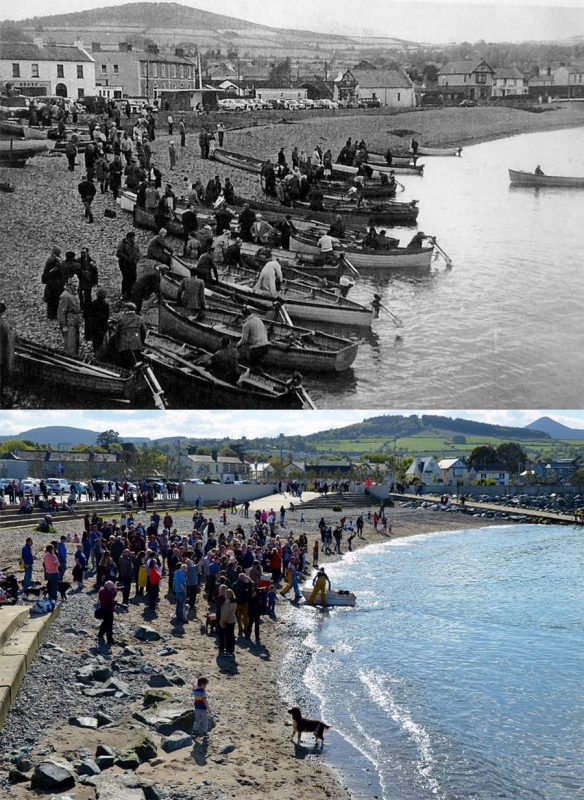 They usually refused, knowing this chap had no experience of the sea, but he finally wore them down and they set off early one morning. It wasn’t long before he began to look a bit green in the face and suddenly leaned over the side and threw up into the sea, losing, along with the contents of his stomach, his false teeth.
 As he sat there, the picture of misery, one of the others had a bright idea. He took out his own false choppers, tied them to the end of his fishing line, and cast off into the waves. After a suitable time he began to reel in again, making sure that as the hook came back on board it passed in front of the gummy passenger. The guy jumped up! “You got me teeth! You got me teeth!! I don’t believe it!!!” He grabbed the end of the line and frantically untied the teeth, thrusting them into his gob. He gave a few chomps, looked puzzled, took them out and looked at them anew and askew.
 “They’re not my effing teeth!” he said in disgust, and threw them overboard before the owner could do a thing but give an agonized groan.


When the labourer’s cottages were built in Lower Windgates in 1911, the rent was one shilling and ninepence per week. I still have the rentbooks. The water had to be carried from the top of the hill in the earlier years but a pump was installed on the road outside the cottages later. My Aunt Kitty still carried buckets from the pump in the 1960s.

Aunt Kitty bringing home the water
Another interesting Windgates connection concerns the lovely sculpture that stands in the garden behind the Custom House in Dublin. Yann Reynard Goulet was the sculptor and the model for the lady in the piece was in fact a Windgates girl. She posed for Yann in his studio at Duncairn Avenue and the story of what happened was told to me by Mairin O’Byrne, who was responsible for starting the Childrens’ Library in Bray, and later became Chief Librarian of Ireland. After she retired I visited her for chats at her home in Glenageary, and she told me the story.

Yann Goulet’s Custom House sculpture
It seems that some busybody got wind of the fact that a young lady was posing in the nude, and went straight to the Parish priest to complain. Our man of the cloth wasn’t too concerned about it, but thought he had better follow up the complaint in order to placate his lady parishioner. He didn’t want to go to Yann’s place alone so decided to ask the local Librarian, Mairin, to accompany him so as to have a witness to anything that might occur. Mairin agreed and they duly turned up at the studio door, which was opened by Yann to reveal our Windgates girl posing in all her glory.

Windgates House 1950s Ray Cranley
However, on seeing the priest, the unfortunate model grabbed at some clothes and vanished into another room, Yann later told Mairin that the girl never returned to her job after that, but the sculpture was almost complete anyway.
In the field opposite the cottages, on Fox’s farm, there is a large depression, said to be a marl hole used in the building of some of the more ancient mud-walled cottages close by. Around 1940 a gang of the neighbours were in the field sleighing after a snowfall.

Pic: Albert O’Donnell
The marl hole was used to get speed up as the sleigh came down the field, usually with three or four on board. When it emerged speeding from the hole it headed for the hedge which bordered the main road, and all would tumble off before letting it run empty into the hedge.
On one occasion however, everyone except my uncle Noel James got off and the sleigh actually went over the hedge and landed on the main road just after the 84 bus had passed up the hill. Noel was screaming “I’m dead!”, but it turned out he was fine. Noel worked on D’Arcy’s farm, as did many locals, especially at harvest time.  Indeed, D’Arcy’s lorry was the mode of transport used when my Granny James moved back from Dublin to the family home in 1933.
 Indeed, D’Arcy’s lorry was the mode of transport used when my Granny James moved back from Dublin to the family home in 1933.
A little mystery now. As small kids, my brother and I used to collect seashells from the roadside banks all the way from the top of Windgates hill down to Booth’s Hollow. I have never been able to ascertain the reason for their presence.  Even now, with much of the banks dug away for road-widening, the odd shell can still be seen there. Are they there since the ‘new’ main road was made in the 1600s? Or from when Windgates was under the sea?
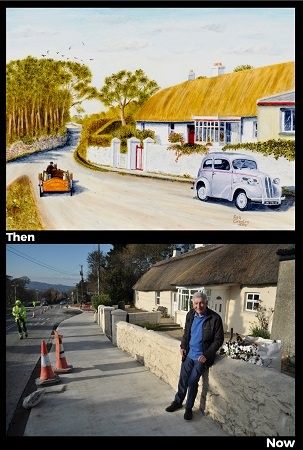 Even now, with much of the banks dug away for road-widening, the odd shell can still be seen there. Are they there since the ‘new’ main road was made in the 1600s? Or from when Windgates was under the sea?
And where’s Booth’s Hollow? Well, just on the Blacklion side of the graveyard, the main road dipped in to the left and back out again, and that dip was known as Booth’s Hollow, or Holla, as we usually said it. I think it quite probable that there was a pub there in the dim past, as I read a very old report of a man being attacked in the area and ‘a publican called Booth’ coming to his aid.
And there has to be a ghost story! In an old book imaginatively called Irish Ghost Stories, there is an account of a man  walking from Greystones to Bray in the 1800s, and as he passed around the Half Moon a ghostly figure appeared from the woods on his left, ran across the road and disappeared over the wall on the Bray Head side. On relating his story he was informed that it was the well-known spirit of a poacher who had been shot by the gamekeeper in Killruddery and that his body had been found on the other side of the wall where the man had seen his ghost disappear.
 walking from Greystones to Bray in the 1800s, and as he passed around the Half Moon a ghostly figure appeared from the woods on his left, ran across the road and disappeared over the wall on the Bray Head side. On relating his story he was informed that it was the well-known spirit of a poacher who had been shot by the gamekeeper in Killruddery and that his body had been found on the other side of the wall where the man had seen his ghost disappear.
Half Moon 1970s. Pic: Harry Acheson


5 comments
What about The Hoey’s of 53 lower Windgates. Jack Hoey lived there. There were a couple of articles about him and his son and wife. Patrica lives there now. I started school in Bray.
Ann or Aine
Thanks for your sweet, sweet message, Ann. Didn’t set out to do a complete census on every single person who ever lived on Windgates Hill – just the ones we knew something about. If you want to put together a history of Jack Hoey and co at 53 lower Windgates with a selection of images of the family and the home, we’ll get that out there. Email is [email protected]. Looking forward to it…
Just to add a bit about ‘Booth’s Hollow’. That bend and dip in the old road was the boundary of Coolagad’s farmland. In the 1950’s or early 60’s the powers-that-be took a slice of Coolagad land – then owned by the Fox family- to put through a wider, straighter road, running from the Coolagad gates to where Circle K is now. That left ‘Booth’s Hollow’ cut off and semi-abandoned. Not much now remains of that old roadway, due to later construction and infill to prevent halting sites.
For many years from the mid-Nineteenth century on, the large field that bordered the road was leased from Richard Fox by one Mister Booth. Hence the name, I believe.
.My great grandfather Richard Fox came from Windsgate. He married Elizabeth Byrne Jan 7th 1846. I’ve no idea if they married in Wicklow or Dublin. I know the marriage was frowned upon because Richard married a Catholic. They moved to Dublin. Richard worked for Arthur Guinness. One son that I know of was my grandfather also Richsrd Fox. worked for Guinness I’ve very little of of Fox family history sad to say. My father Joe Fox also worked for Guinness had 6 children 3 sons and 3 daughters. First born was Richsed Fox. We were all born and raised in Dubkin. We grew up never knowing if we had family by the name of Fox.
I live in Toronto, Canada. I’m going back to Ireland in May , 2026 staying with my friend in Bray. Oh there’s on more connection a Christopher Fox of Windsgate R.I.P. his wife worked for R.TE. I’ve lost her contact information. If anyone can please give me advise how I can find outmore information Id really appreciate it.
Thank yiu so much.
Anna Fox
Granny Darcy brought all the grandchildren up Bray head every St Patrick’s day. We’d go to Breen’s shop in Blacklion to pick our fizzy (I always went for the raspberry) and then off to the half moon. Jumpers tied around our waists. Up the lane, past a farm, up to the hillocks and the Cross. It was a lovely yearly event. She was great.