1.4K 
Over the course of a frantic 20-minute period between 00.02hrs and 00.22hrs on May 31st, the watch followed the set procedure, phoning Air Defence Command in Dublin on no fewer than five occasions to pass on the information.

Whilst the truth of why Dublin was bombed by the Luftwaffe on 31st May 1941 may never be known, the consensus view is that it was the result of a tragic mistake made by two of the large number of German bombers that flew up along the Irish coast that fateful night. The log book covering May 1941 for the Bray Head Look Out Post No.8 reveals that the activity level in the skies above Bray Head reached a peak during that month.


Show me a sign…
 t was back in August 2018 that, after a four-day gorse
  fire, an old World War 2 outpost was unearthed on Bray Head.
 t was back in August 2018 that, after a
  fire, an old World War 2 outpost was
 Before Maguire & Patterson though, local historians Slattery & Byrne had been digging away at Look Out Post No. 8 for quite a few years.
 And now, on the 80th anniversary of the Luftwaffe trying to level Dublin, Gary Paine takes a leaf or two out of his Pictorial History Of Greystones Vol.8 to chart just how the men posted Bray Head found their nightwatch shift suddenly interrupted by the sound of bomber planes coming up over the North Beach…
 And now, on the 80th anniversary of the Luftwaffe trying to level Dublin, Gary Paine takes a leaf or two out of his Pictorial History Of Greystones Vol.8 to chart just how the men posted Bray Head found their nightwatch shift suddenly interrupted by the sound of bomber planes coming up over the North Beach…
We’ll let the young Paine lad take it from here…
 The 30th of May, 1941 began like any other day for the two-man watch on duty at Look Out Post No.8 of the Coast Watching Service situated on the southern slopes of Bray Head.
 The 30th of May, 1941 began like any other day for the two-man watch on duty at Look Out Post No.8 of the Coast Watching Service situated on the southern slopes of Bray Head.
Weather conditions were moderate and during the course of the day, no events of note were recorded. It appeared just another routine day, with the watch phoning McCormick’s coal distributors in Bray late morning to order more fuel for the fire.
 As midnight approached the men prepared for the changeover of the watch. No sooner had the new watch taken over than the sound of aircraft travelling north past Greystones was heard.

Over the course of a frantic 20-minute period between 00.02hrs and 00.22hrs on May 31st, the watch followed the set procedure, phoning Air Defence Command in Dublin on no fewer than five occasions to pass on the information.  By the time dawn broke on Saturday, May 31st 1941, death and destruction had been brought to Dublin’s North Strand. The toll of fatalities would eventually rise to 28.
 By the time dawn broke on Saturday, May 31st 1941, death and destruction had been brought to Dublin’s North Strand. The toll of fatalities would eventually rise to 28.
 Examination of the log book records at The Military Archives, Cathal Brugha Barracks, Dublin reveals that Look Out Post No.14 at Carnsore Point observed the first wave of aircraft heading north along the Wexford coast at 23.40hrs. At 23.48hrs, the air raid alarm was sounded in Dublin and a code Yellow preliminary air raid warning was issued. Dublin’s air
  defences – comprising the city’s anti-aircraft guns, searchlights and men – went on standby.
At 23.56hrs, Look Out Post No.9 on Wicklow Head recorded ‘sound of aircraft 7 miles southeast of post, going north, visibility moderate. Emergency on, heard continuous sound of aircraft going north from 00.00hrs to 01.45hrs’. At 23.58hrs, air raid warning code Red was issued to the gun crews manning Dublin’s anti-aircraft artillery. ‘The reports from Air Defence Command Control carried information that seemed to indicate a developing threat to the city.’
 Examination of the log book records at The Military Archives, Cathal Brugha Barracks, Dublin reveals that Look Out Post No.14 at Carnsore Point observed the first wave of aircraft heading north along the Wexford coast at 23.40hrs. At 23.48hrs, the air raid alarm was sounded in Dublin and a code Yellow preliminary air raid warning was issued. Dublin’s air
  defences – comprising the city’s anti-aircraft guns, searchlights and men – went on standby.
  At 00.35hrs, Clontarf Battery was the first of the Dublin anti-aircraft defences to open fire, discharging four rounds at an aircraft caught in a searchlight beam, heading north to east at around 7,000 feet. Between 01.28hrs and 01.30hrs, the Clontarf, Ringsend, Collinstown, Stillorgan and Ballyfermot Batteries all opened fire at aircraft crossing the city. At 02.05hrs, the fourth and largest of the bombs dropped on Dublin (estimated at 500lbs) landed on tram tracks on the North Strand.

 At 02.14hrs, Look Out Post No.8 on Bray Head recorded ‘heard sound of aircraft 4 miles west of post travelling south, also heard a lot of explosions east of post, visibility moderate, phoned Air Defence Command’. At 02.15hrs, the aircraft believed to be the one which dropped the large bomb on the North Strand passed Wicklow Head heading south.

At 03.50hrs, Look Out Post No.8 on Bray Head recorded ‘heard sound of aircraft northeast of post, then sighted it passing post, type Junker’. This aircraft is believed to have been a straggler from the main waves of bombers.

Heinkell HE 111
Dalkey Look Out Post No.7 is recorded as having shot at this aircraft with machine gun fire as it passed by. The Dalkey Look Out Post was incorporated into a larger military establishment which had a searchlight and sound detectors.
Whilst the truth of why Dublin was bombed by the Luftwaffe on 31st May 1941 may never be known, the consensus view is that it was the result of a tragic mistake made by two of the large number of German bombers that flew up along the Irish coast that fateful night. The log book covering May 1941 for the Bray Head Look Out Post No.8 reveals that the activity level in the skies above Bray Head reached a peak during that month.  There was scarcely a night that the din of aircraft flying along the Wicklow coast was not heard. It was well known that the Luftwaffe used the geographic reference point of Bray Head and the lights of Dublin (which was not subject to the full blackout regulations of British cities) on their bombing raids over Liverpool. Planes regularly flew up the Irish coast at a distance of five miles, just outside the three-mile territorial limit, before banking to the east and heading for Liverpool and its docks, a key target of the Germans in the Battle of the Atlantic.
 There was scarcely a night that the din of aircraft flying along the Wicklow coast was not heard. It was well known that the Luftwaffe used the geographic reference point of Bray Head and the lights of Dublin (which was not subject to the full blackout regulations of British cities) on their bombing raids over Liverpool. Planes regularly flew up the Irish coast at a distance of five miles, just outside the three-mile territorial limit, before banking to the east and heading for Liverpool and its docks, a key target of the Germans in the Battle of the Atlantic.
 In April and early May 1941, Belfast was blitzed on a number of nights, with the death toll reaching more than 900. It was quite common for German aircraft to become lost in their search for the docks of Cardiff, Liverpool and Belfast. It was paramount that the crew and aircraft return safely to Germany. This necessitated the jettisoning of the aircraft’s bombs to lighten the plane and preserve fuel to ensure a successful return to Germany.
  It is telling that, in the five minutes prior to the dropping of the first bomb on Dublin at 01.30hrs on the fateful night of 30th 31st May 1941, the men in the Bray Head Look Out Post recorded hearing loud explosions on two separate occasions out to sea as the majority of German aircraft jettisoned their bombs.


Sadly for the people of the North Strand, it appears that two of the German aircraft inadvertently jettisoned theirs over the city and not the sea as intended, with tragic consequences. Three nights before the North Strand bombing, on 28th May 1941, over 50 German bombers flew up along the Wicklow coast, observed by the men on watch on Bray Head. They almost bombed Dublin in error, but passed to the east of the city. They were possibly looking for Cardiff or Liverpool, but seeing that the land differed to their bomb-aimer’s map, they dropped their bombs off the coast instead. The Bray Head look out post recorded hearing continual loud explosions and seeing bright flashes out to sea between midnight and 02.00hrs.

De Valera visits North Strand bomb site
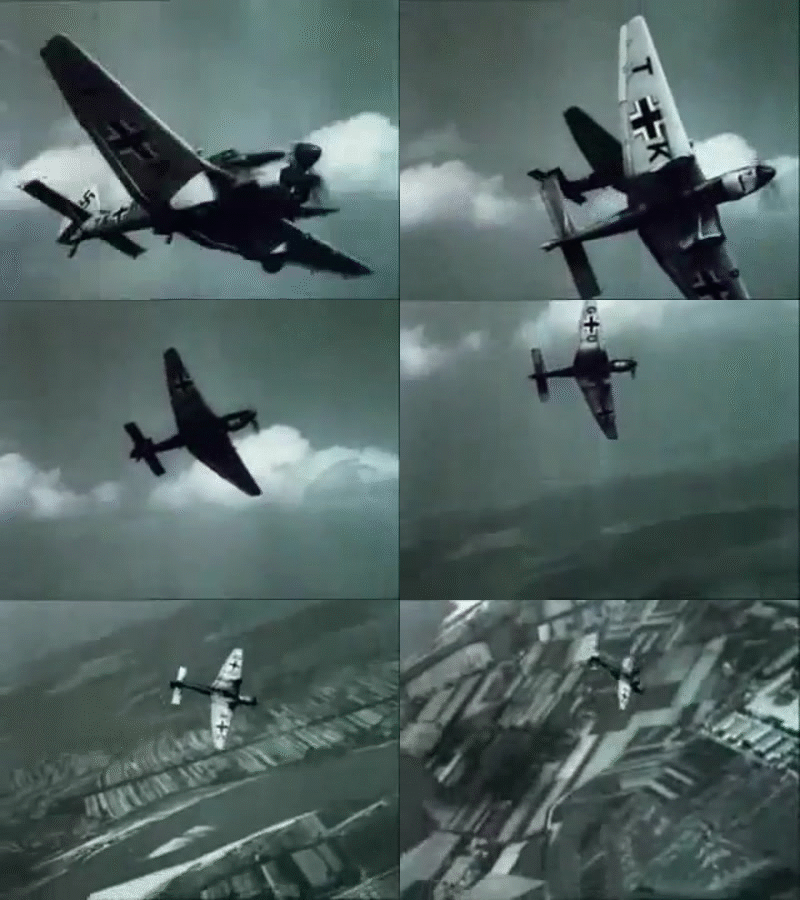 Whilst these events are interesting, the Bray Head Look Out Post No.8’s most important observations were undoubtedly the recording of the waves of Luftwaffe bombers flying up the Wicklow coast on the night of May 30th into the 31st, 1941, on their way to one of the most significant World War 2 events that impacted Ireland – the bombing of Dublin’s North Strand.