1.3K 

Thursday, 25th September 2025

Friday, 26th of September 2025
Saturday, 27th of September 2025

We hit the road at 7.45am with steely determination, ignoring the impatience that seems to turn normally calm Polish citizens into raging lunatics once they’re on the motorway. Going past Krakow, an accident ahead slowed traffic down to a crawl.
You also notice a distinct lack of young men about. Many of the famously fertile Ukrainian fields look like they’ve been left abandoned due to the ongoing lack of manpower in the countryside. At the graveyards in each town or village, you can spot the freshly fallen defenders’ graves by their national blue-and-yellow flags (for the blue sky and the yellow harvest) and the black-and-red wartime ones.
The bigger towns in particular, have very few outward signs of war going on, but the reminders are always there – the colour billboards or posters erected in the town centres showing those who recently died in defence of their country; ensuring that absolutely nobody is forgotten.
Wednesday, 1st of October 2025
The children applauded each of us as we straggled into the school hall. We took our places and the performance involving traditional music, dress and dance was hypnotic. The dancing, in particular, was so well choreographed and executed that one couldn’t help thinking of what kind of macabre dance awaited the young men in a few short years, if the war continues.
Thursday, 2nd of October 2025

We travelled by coach to the Polish border, got off, crossed on foot and got another coach on the other side that was to take us to Krakow and the flight back to Ireland. Coming back into the EU was an even more marked experience than going into Ukraine a few days beforehand. I looked back up at the frontier. A tall fence topped with razor wire extended over the fields as far as the eye could see. There were watchtowers. I never thought that entering the EU would feel so wonderful – from a war zone fraught with underlying tension to one of freedom, stability and prosperity.
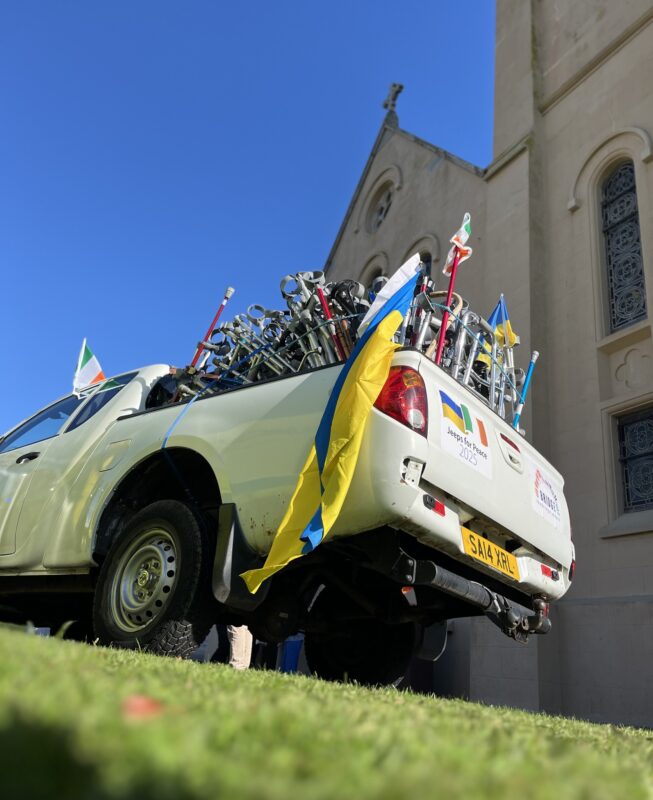
Getting ready to roll… THURS25SEPT25 Holy Rosary
 ollowing a blessing at The Holy Rosary, 30 local volunteers with a
  fleet of 8 jeeps, 2 ambulances, 3 pick-up trucks and a minibus joined this year’s Jeeps For Peace aid convoy to the Ukraine.
 ollowing a blessing at The Holy Rosary, 30 local volunteers with a
  fleet of 8 jeeps, 2 ambulances, 3 pick-up trucks and a minibus joined this year’s Jeeps For Peace aid convoy to the Ukraine.
It’s not the first time, of course, this community-to-community effort being all about getting vehicles and supplies directly into the hands of those who need them far more than we do.
 In Ukraine the jeeps are used to ferry the wounded from the battlefield to field hospitals where they can receive urgent lifesaving treatment before the ambulances transfer them to specialist hospitals. A jeep has an average life expectancy of just 90 days.
Also included in this year’s convoy was a mobile kitchen, donated to army chaplain Fr Ivan Gunya and the Ukrainian Greek Catholic Church.
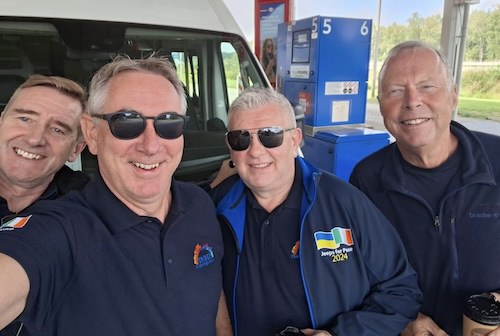
Eddie Evans, Conor Power, Luke Ferguson and Doney Flinn get ready to roll…
As to to the 2,750km journey across Europe and into Ukraine, Conor Power kept a diary for the Guide…
Thursday, 25th September 2025
The gathering of our multi-vehicle trans-Europe odyssey began at the Maxol Filling Station in Bray, where their generosity stretched to filling up each jeep, ambulance, pick-up, minibus, as well as a gift pack for each of the 30-odd volunteers.
At the Church of the Holy Rosary, a crowd had gathered and the Virgin Media cameras were rolling. Dressed in our Jeeps for Peace Ireland gear, we stood for the joint ecumenical service and listened to the great music with singer-songwriter Nathan Johnston and Fin Furey.
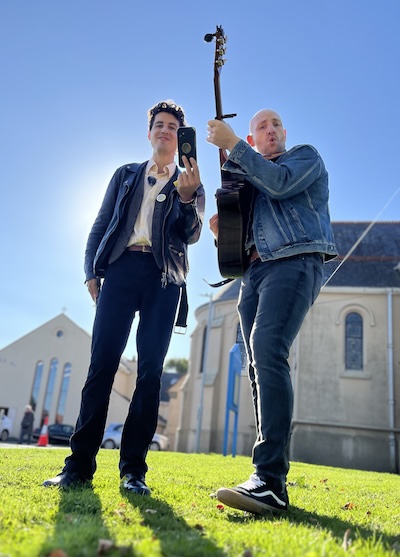
Nathan Johnston & Fin Furey get ready to rock…
Outside in brilliant early afternoon sunshine, our vehicles were blessed by Catholic and Protestant bishops before we took off with great excitement and noise, Ukrainian and Irish flags fluttering, ambulance sirens blaring and onlookers cheering.
This was my first time on this trip but it’s the third such one. It began with 6 people, then 12 last year This year, there are 30.
Friday, 26th of September 2025
Whatever about the power of bishops on the vehicles themselves, we were certainly blessed with the weather on the crossing. It was as smooth as it could possibly have been and soon the French coast emerged before us as the weather got decidedly drizzly. It was exciting to suddenly find our precious cavalcade on French tarmac. Using Google Maps and WhatsApp, we could all see where we were in relation to one another. Our vehicle was the only one fitted with a speed limiter, so we couldn’t drive any faster than 100kph on roads where the speed limit was normally 130.
 We took turns at the wheel. We were three at this point, rotating the roles of driver, navigator and passenger in a minibus that had few seats available, so crammed it was with equipment, pharmaceuticals and even boxes of crisps (kindly donated by Keoghs).

It was a 560-kilometre trip and it took us almost 8 hours, arriving at the Menin Gate in Belgium with just 10 minutes to spare to watch the solemn ceremony of The Last Post. The memorial was much larger than I had imagined (I thought it would be a simple Roman arch) and into its interior walls and roof are chiselled the names of 90,000 British and Commonwealth soldiers whose bodies were never recovered. This is only a small proportion of the approximately 1,000,000 who died in the area during World War 1.
The nightly ceremony happens every single evening at 8pm. Taking some slight poetic licence, we managed to find parking spaces beside the hotel in this town that was reduced to rubble over one hundred years ago and whose centre has been rebuilt in stunning beauty, remaining faithful to its original Flemish architecture. It’s a sobering example of both the madness of war and of the determination of the human spirit to rebuild.

Saturday, 27th of September 2025
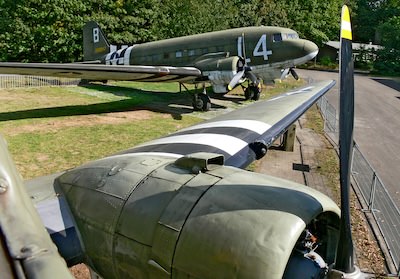
After a hearty breakfast and a slow start, we kicked into gear for the next stage – 530km to Kassel in Germany, via the Netherlands and the Wings of Liberation Museum outside Eindhoven.  We were now 4, after being joined by Eddie in Ypres. On the way, we had our first vehicle casualty when Noel and Roc’s jeep blew a radiator. The network of Jeeps-for-Peace members swung into action and had organised the repair of the stricken vehicle, while we continued re-distributing the two volunteers and their belongings to other vehicles.
 We were now 4, after being joined by Eddie in Ypres. On the way, we had our first vehicle casualty when Noel and Roc’s jeep blew a radiator. The network of Jeeps-for-Peace members swung into action and had organised the repair of the stricken vehicle, while we continued re-distributing the two volunteers and their belongings to other vehicles.
Wings of Liberation is a great reminder of the doomed Operation Market Garden, when the Anglo-American forces in 1944 tried to get behind enemy lines in Holland so as to facilitate the liberation of the country. Its failure meant that Amsterdam didn’t get liberated until the very end of the war – something that, incidentally, was the difference between life and death for Anne Frank.
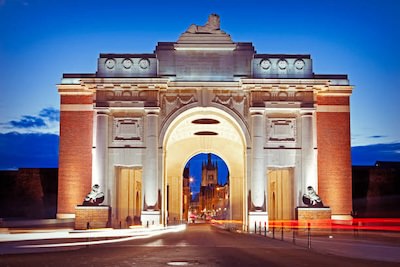
The Menin Gate Memorial in Ypres
Just before crossing the Meuse and the German border, we filled up on American-style fast food, and onwards we sped through the built-up Ruhrgebiet. It’s astounding how Europe has evolved over the last eight decades. Now, there are virtually no borders. Only for the language on the signs changing from one country to the next, you’d hardly be aware of having crossed from one country into another.
Kassel is a fine town and, even though we didn’t get much of a chance to absorb German culture (we ate in an Italian restaurant before a digestif or two at an Irish bar), it was thrill to find ourselves more-or-less halfway there.
Sunday, 28th of September 2025
There was no time for either mass or Sunday Service for those on a mission from God! It was another slow start but we got through the gears quickly after another sumptuous breakfast on another splendidly sunny day. Today, we were travelling through another large chunk of Germany. Our destination was Leipzig, with a stop en route at the famous Colditz Castle.

The castle overlooks a sleepy town of the same name and housed Allied prisoners of war of the officer class. For the Germans, the higher-up and more well-connected they were, the better, because they felt that valuable prisoners would make valuable negotiating pawns if and when the time came.
When I was young, a BBC TV series Colditz used to be on, based on the stories of the prisoners of Colditz and I thought it was a fictional place. Inside, a slightly clunky tablet system leads you through the castle, telling you some of the fascinating stories of escape, capture, death, etc. It was interesting to see the statistics on escape attempts by nationality. The Brits really tried hard (109 attempts) with a small percentage return (11 successful), while the French were successful in half of their 24 escape attempts.

We had lunch at a restaurant in the shadow of the castle and for once, we had the feeling of being in Germany; in a typical charming German town that had hardly changed much over the previous 200 years, set within some beautiful rolling countryside. Our stay at at the Leipzig Radisson Blu was very comfortable and was right across the busy wide Augustusplatz from the stunning opera house.
 Monday, 29th of September 2025
Today was the biggest drive of the trip – a mammoth run across virtually the entire width of Poland, plus a piece of Germany, to Jaroslaw near the Polish-Ukrainian border. 845 kilometres. With the speed limit on Polish motorways being 140km/h, our 100km/h limit meant that Google Map’s estimate of 8.5 hours was likely to be very optimistic. Between the 4 of us, we made a rough plan of action, ensuring to keep stopovers to a minimum and to rotate our roles in the van as we went along.
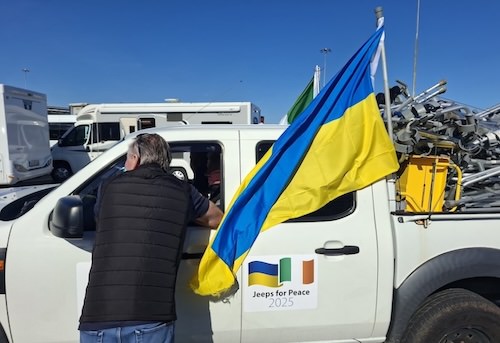 Monday, 29th of September 2025
We hit the road at 7.45am with steely determination, ignoring the impatience that seems to turn normally calm Polish citizens into raging lunatics once they’re on the motorway. Going past Krakow, an accident ahead slowed traffic down to a crawl.  It lasted about an hour in all, pushing out our arrival time by some distance. It also lengthened my turn at the wheel from 2.5 hours to 3.5 hours and I was feeling the exhaustion by the time we made our final motorway coffee stop about 45 minutes from Jaroslaw.
 It lasted about an hour in all, pushing out our arrival time by some distance. It also lengthened my turn at the wheel from 2.5 hours to 3.5 hours and I was feeling the exhaustion by the time we made our final motorway coffee stop about 45 minutes from Jaroslaw.
At a huge timbered venue with a massive roof, we joined forces with the 30+ Scottish contingent and another 15 or so cyclists from Ireland. These latter were due to cycle the last 15km or so as we entered both Kolomyia and Lviv in Ukraine.
 Tuesday, 30th of September 2025
It was an extra early start this morning to be at the border by 6am. Crossing into Ukraine with such an amount of equipment and people can be very slow and we were allowing a full six hours in case they were needed. There was a change-around of vehicles and I ended up in the one carrying the cyclists and a 5-person camera crew. This was separate to our own 2-man official camera crew, who were coming in their own vehicle farther back along the line.

As we were with the cyclists, ours was one of the first through the border. The Polish border guards were sullen compared to their smiling Ukrainian counterparts but both were doing their job as thoroughly as possible. Fortunately, they didn’t go through every item of baggage and equipment on board and we were mildly surprised to find ourselves in Ukraine after about half an hour.

I found myself instantly looking around for signs of war, for signs of something completely different, now that we were in a war zone. Nothing particularly jumped out. It just looked like a slightly less wealthy version of Poland.
The camera crew had a rendezvous with Ukrainian colleagues just over the border and they went their separate way while we called to the first petrol station to get fuel, coffee and snacks. Everything was considerably cheaper and all places take cards.
 I was in the navigator position with David from Scotland who was the driver of the minibus. Having lived in the Ukraine over the years, bought property here and married a Ukrainian woman (she was from the Donbass and a Russian army general is now living in her parents’ home, he told us), he was the perfect guide. He also knew how to surf-drive over the insanely potholed secondary roads in Ukraine. “This is what they call a good road in the Donbass!” he joked as he tore over the pockmarked road at speed so as to lessen the chance of getting a puncture.
 I was in the navigator position with David from Scotland who was the driver of the minibus. Having lived in the Ukraine over the years, bought property here and married a Ukrainian woman (she was from the Donbass and a Russian army general is now living in her parents’ home, he told us), he was the perfect guide. He also knew how to surf-drive over the insanely potholed secondary roads in Ukraine. “This is what they call a good road in the Donbass!” he joked as he tore over the pockmarked road at speed so as to lessen the chance of getting a puncture.
At the next snack stop, we encountered our first Ukrainian soldier. A man in his 50s, he struggled on a crutch. He wouldn’t have any of it when David tried to pay for his coffee and settled for a handshake and words of appreciation. Driving through Ukrainian villages, most are very inviting and pretty and in most cases, the standout building is the Orthodox Church, whose glittering gold and silver roofs shimmer from kilometres away.
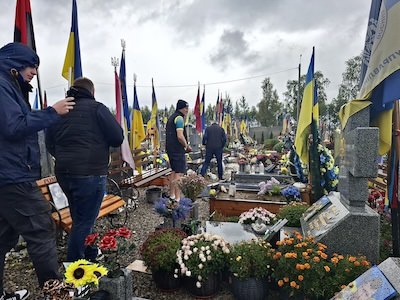
You also notice a distinct lack of young men about. Many of the famously fertile Ukrainian fields look like they’ve been left abandoned due to the ongoing lack of manpower in the countryside. At the graveyards in each town or village, you can spot the freshly fallen defenders’ graves by their national blue-and-yellow flags (for the blue sky and the yellow harvest) and the black-and-red wartime ones.  “It’s what happens when you pour blood on the national flag – you get black and red,” David explained.
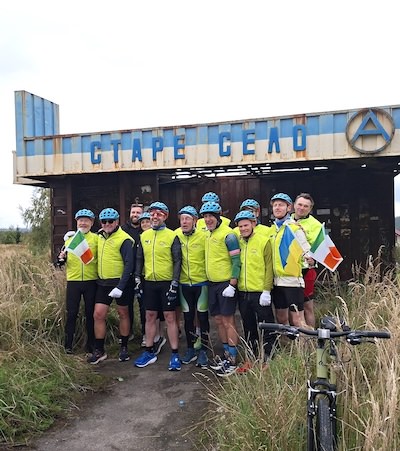 “It’s what happens when you pour blood on the national flag – you get black and red,” David explained.
For the final 15 kilometres into our destination town of Kolomyia, the bikes were produced and the cyclists bravely pedalled in the unrelenting rain and heavy traffic. There was a small civic reception at the main square in Kolomyia – a pretty town about the size of Waterford City. We got out of the cold rain and into our hotels. We got the news that our camera team of Kilkenny natives Diarmuid and Shane had been turned back at the border because, despite all our careful preparation, they allegedly didn’t have the correct paperwork for their equipment.
Outside of town, there was a big reception for all of us. Laid out like a wedding banquet, there were representatives from local military, police and civic organisations. As a surprise, we had learned off the Ukrainian national anthem and our rendition of it was greatly appreciated.
The bigger towns in particular, have very few outward signs of war going on, but the reminders are always there – the colour billboards or posters erected in the town centres showing those who recently died in defence of their country; ensuring that absolutely nobody is forgotten.  At 9am every morning, there is a minute’s silence to remember the fallen. Everything stops. There is a discreet announcement on the tannoy – so discreet that you can easily miss it or mistake it for something else. The cars, buses and trams come to a disciplined halt, like in a film. And then, life resumes once more. The dead or not forgotten but they refused to be bowed and bullied.

Wednesday, 1st of October 2025
It was another early start in rainy Kolomyia and after a quick breakfast, the minibus came to collect us to go to a local secondary school, where students were putting on a special concert for us.
We had some trouble finding the school and arrived about half an hour late. It wasn’t our fault, however. The Ukrainian defence forces often scramble the signals governing Google Maps so as to foil drone attacks. This part of Western Ukraine hadn’t been hit in quite a while but it has been attacked before, with Russian drones and missiles seeking primarily to terrorise the populace rather than concentrate on strategic targets.

The children applauded each of us as we straggled into the school hall. We took our places and the performance involving traditional music, dress and dance was hypnotic. The dancing, in particular, was so well choreographed and executed that one couldn’t help thinking of what kind of macabre dance awaited the young men in a few short years, if the war continues.  Down the corridor, a corner area had become something of a shrine, bedecked with photographs of the dead fathers; there were already so many of them. It was heart-rending and our own star Nathan Johnston joined the children for a final song on stage.
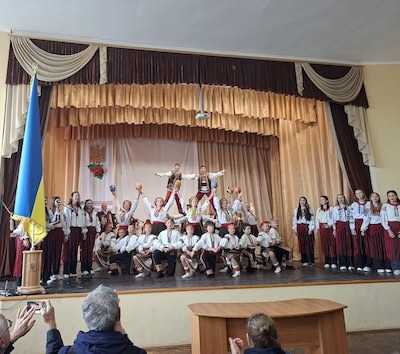 Down the corridor, a corner area had become something of a shrine, bedecked with photographs of the dead fathers; there were already so many of them. It was heart-rending and our own star Nathan Johnston joined the children for a final song on stage.
We piled back into the minibus and headed for Lviv. Today was Defenders’ Day, when all fallen defenders are especially remembered and there was a rumour circulating that President Zelensky himself was going to be in Lviv. Along the way, David took a small diversion to a large graveyard. It was deeply saddening to walk through the graves. There were so many of them and so many more evidently to come. Each one bore the name of the occupant, their age, their nom de guerre and a colour photo of them. They ranged from the late teens to the early 50s.
 The rumours of Zelensky’s presence proved to be unfounded but the Minister of Police and his Polish counterpart were in the city, which meant that our planned-for police escort into Lviv for the cyclists didn’t happen due to staffing shortages. That didn’t deter the cyclists and we arrived to a warm reception in the town square.
 The rumours of Zelensky’s presence proved to be unfounded but the Minister of Police and his Polish counterpart were in the city, which meant that our planned-for police escort into Lviv for the cyclists didn’t happen due to staffing shortages. That didn’t deter the cyclists and we arrived to a warm reception in the town square.
We were all at the same central hotel – The George. It was old-world charm at its best and there was more than a hint of London during the Blitz about it, with real room keys, 4-metre-high ceilings and a sign indicating the bomb shelter.
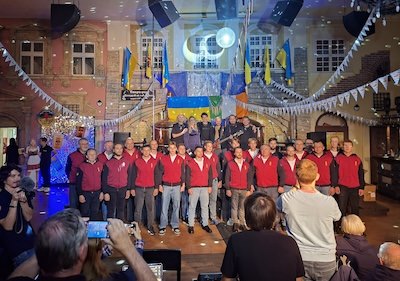
Our farewell meal and concert was at a large venue just a short walk away – Stargorod. There was a large crowd of locals in attendance joining the 100 or so from Scotland and Ireland. Nathan Johnston was superb, as was Ukrainian opera-trained singer Tatyana and an incredible local men’s choir.
 Outside, I got chatting to a 20-year-old English guy called Harrison. He was hobbling on a crutch and explained that he’d “fucked up” his back – unclear if it was a war-induced injury or not. He had run away to join the Ukrainian army at the age of 18. Initially serving with the infantry in the Ukrainian Foreign Legion, he was now farther behind front lines in ‘engineering’ – aka drone killing. He said that his unit had claimed al lot of Russian casualties and destroyed plenty of their hardware.
 Outside, I got chatting to a 20-year-old English guy called Harrison. He was hobbling on a crutch and explained that he’d “fucked up” his back – unclear if it was a war-induced injury or not. He had run away to join the Ukrainian army at the age of 18. Initially serving with the infantry in the Ukrainian Foreign Legion, he was now farther behind front lines in ‘engineering’ – aka drone killing. He said that his unit had claimed al lot of Russian casualties and destroyed plenty of their hardware.
Thursday, 2nd of October 2025
The midnight curfew in effect in Lviv meant that nobody stayed out too late and we were all packed, breakfasted and ready to go before 9am.
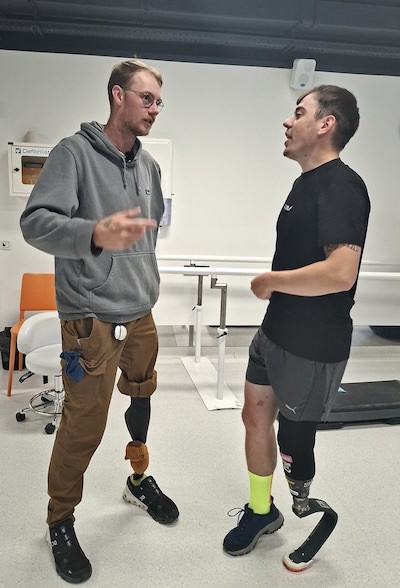
At the Superhumans Center on the outskirts of Lviv, we met another English volunteer. Eddy Scott from Dorset came on a humanitarian mission, however. Last January, he was ferrying citizens from a war zone near Pokrovsk (Donetsk) when the clearly-marked white jeep he was driving was targeted by a Russian drone pilot. Eddy lost his left arm and his left leg.

The Superhumans Center is at the cutting edge of physical and psychological rehabilitation. There’s an incredibly positive ambience about the place, a determination to not let their injuries get the better of them etched on the faces of every mutilated soldier there.
Eddy Scott (left)