462 

Over the following 9 weeks (deadline was May 5th) census returns poured in from parishes across the country. The quality of the returns received varied greatly, however.
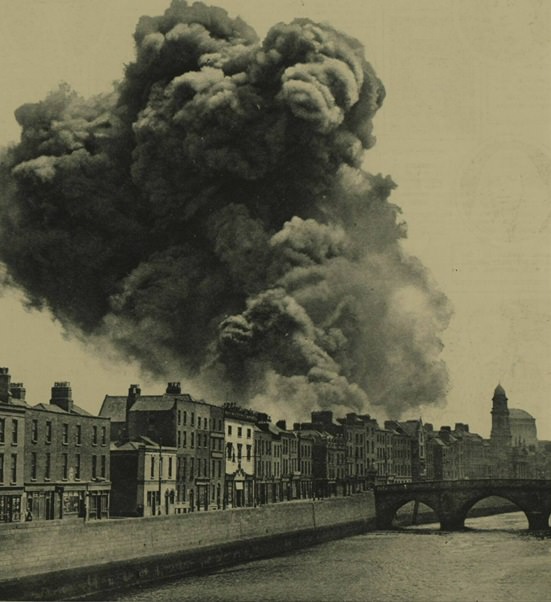
The returns were later stored in the Public Record Office where most were destroyed in the explosion and fire on June 30th 1922. But, because many of the returns were useful for genealogists, they proved popular with researchers, and copies of many of the returns had been taken by researchers before 1922. After the Public Record Office was destroyed, and the original returns
The Virtual Record Treasury of Ireland project, based at Trinity College Dublin,

Although most original 1766 census records were destroyed, a small number survived and are preserved in the National Archives.

Delgany, yesterday, just after tea…
 etting out to reconstruct some of the lost historical sources located within the bowels of the Public Record Office from 1922, the Virtual Record Treasury of Ireland project is unearthing some real gems from our past.
 etting out to reconstruct some of the lost historical sources located within the bowels of the Public Record Office from 1922, the Virtual Record Treasury of Ireland project is unearthing some real gems from our past.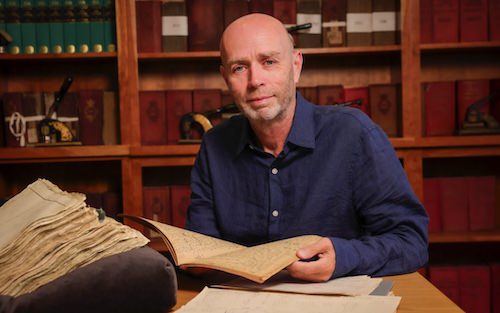
Dr Brian Gurrin
Including, an excited agus delighted Dr Brian Gurrin informs us, the lost 1766 religious census of Ireland for the united parishes of Delgany, Kilcoole and Kilmacanogue.
It was just two weeks ago that Brian found a box of papers of the Revd Nicholas Donnelly, Bishop of Canea, just in time for the 260th birthday of the 1766 census on March 5th.
Over to the bould Brian…
 On March 5th, 1766 the peers in the Irish House of Lords (now the Bank of Ireland building, College Green) requested Church of Ireland parish ministers throughout Ireland to conduct a census of their parishes and send a list of the names every household back to the Lords, noting who was Protestant and who was Roman Catholic. You can see the Lords’ order here.

Over the following 9 weeks (deadline was May 5th) census returns poured in from parishes across the country. The quality of the returns received varied greatly, however. Some ministers complied with the request, while other ministers merely returned population numbers.

The returns were later stored in the Public Record Office where most were destroyed in the explosion and fire on June 30th 1922. But, because many of the returns were useful for genealogists, they proved popular with researchers, and copies of many of the returns had been taken by researchers before 1922. After the Public Record Office was destroyed, and the original returns  lost, many of the transcripts made their way back into archives around Ireland, including the National Archives here and the Public Record Office of Northern Ireland here.
 lost, many of the transcripts made their way back into archives around Ireland, including the National Archives
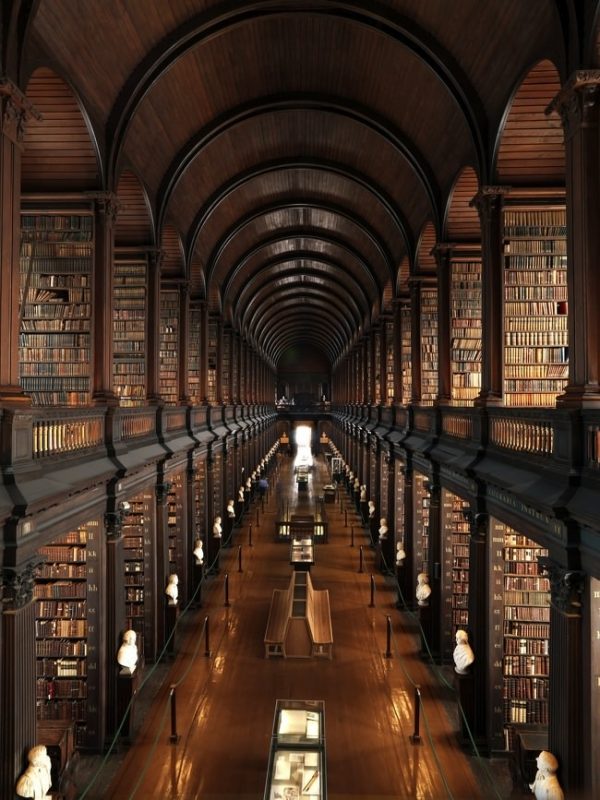
 The Virtual Record Treasury of Ireland project, based at Trinity College Dublin,  is a Government of Ireland funded project, which aims to identify surviving copies of documents which were in the Record Office before it was destroyed, and make these freely available to researchers, on its website here.
 is a Government of Ireland funded project, which aims to identify surviving copies of documents which were in the Record Office before it was destroyed, and make these freely available to researchers, on its website
 The 1766 religious census of Ireland was identified as a key component of the reconstruction, and over the past three years the project has examined about 250,000 individual sheets of paper in archives throughout Ireland, in an effort to identify surviving returns from it, and from other early Irish censuses (1821-1851). Every nugget of information available from the 1766 census is now available on the Virtual Treasury’s website, including 50,000 names surviving from the survey. Our reconstruction of major parts of the 1766 census can be seen in our 1766 Religious Census Gold Seam here.
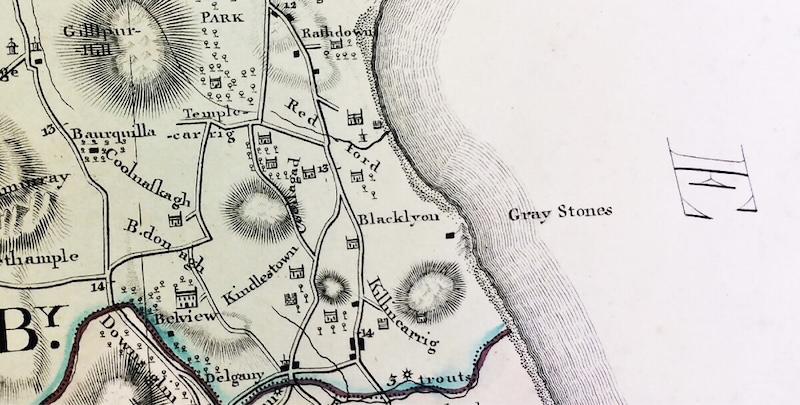
Greystones 1710 before the harbour arrived
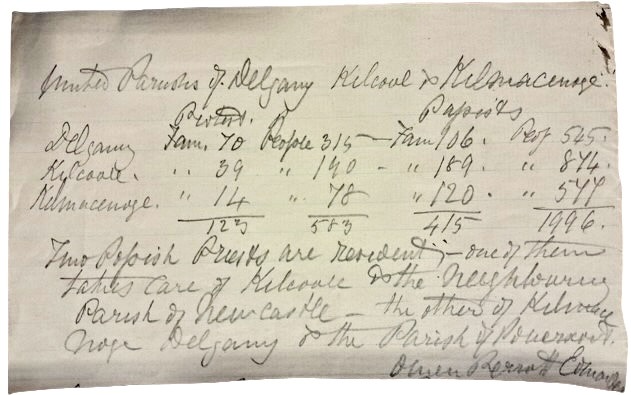
Our most recent discovery (found just two weeks ago) is a complete transcript of the 1766 census return for the united parishes of Delgany, Kilcoole and Kilmacanogue, which was identified in a box of papers in the Dublin Diocesan Archives here (reference: Special Collections, box SC82). The return was made by Revd Owen Perrott Edwardes, curate of Delgany between 1756 and 1771. Like many ministers, Edwardes did not return a list of names of inhabitants, but simply provided population totals. You can see a transcript of the Perrott’s return here.